Buying & selling online
How to Spot Fake Reviews on Amazon, Google and Trustpilot
How to spot fake reviews on Amazon, Google Maps, Tripadvisor and Trustpilot: the red flags, what the FTC rule bans and how to report a suspicious review.
You spot fake reviews by their patterns, not by any single review. Watch for a burst of five-star ratings within a few days, praise with no specifics, reviewers who have only ever written one review and photos that look like they came from a catalog. Read the three- and four-star reviews first, sort by date, and compare what you find on more than one site before you buy.
Star ratings decide which blender ends up in your cart and which contractor gets the job, and that's exactly why they get bought, traded and invented. The FTC announced a rule banning fake reviews in August 2024, but they haven't gone away.
We're building TrustCamera, a camera app that gives photos a check code at the moment they're taken, so we think a lot about what makes a piece of evidence believable. This guide covers the red flags, the federal rules, what Amazon, Google, Trustpilot and Tripadvisor say about their own checks, and how to report a review that looks off.
How to spot fake reviews: the red flags at a glance
To spot fake reviews, look past the average rating and at how the reviews behave as a group. Sudden waves of top ratings, text that never mentions a real detail, near-identical wording, one-review accounts and a total absence of criticism are the classic signs. The more of them show up together, the less the star average tells you.
| Red flag | What it looks like | What to do |
|---|---|---|
| Review burst | Dozens of five-star reviews in a few days after months of quiet | Sort by newest |
| No criticism | Almost all five stars, hardly anything in the middle | Read the three- and four-star reviews |
| Empty praise | "Great product, love it," with no specifics | Look for reviews that describe real use |
| Same wording | Similar sentences or phrases across several reviews | Compare the reviews side by side |
| One-review accounts | The reviewer has never reviewed anything else | Click the profile |
| Off-topic text | The review describes a different product or only the shipping | Check what it's actually about |
| Catalog photos | Review photos look like polished product shots | Run a reverse image search |
A single red flag proves nothing. Real customers write short reviews too, and new products often collect a lot of reviews at launch. The picture changes when several signs line up.
Fake reviews are also often just one part of a bigger setup. An online store that shows glowing testimonials on its own site but has no footprint anywhere else might not be a real store at all. Our guide on how to tell if a website is legit walks through checking the whole shop.
Timing and star patterns: when a burst of reviews is suspicious
The FTC's advice on evaluating online reviews starts with timing: check how recent the reviews are and watch for a burst of reviews over a short period. It also suggests checking whether a reviewer has written other reviews, because an account created just to review one product may be fake. And it's candid about the limits: don't assume you can tell a real review from a fake one just by looking.
The FTC adds two twists that trip people up. Some fake positive reviews deliberately give less than the top rating to seem more believable. And fake reviews aren't always positive, since a company might post fake negative reviews to hurt a competitor. Its advice is to look at a variety of sources, including well-known websites with trustworthy and impartial expert reviews.
In our view, the distribution of stars says a lot as well. A product with a wall of five-star reviews, a cluster of one-star complaints and almost nothing in between doesn't look like something real buyers experienced in different ways. The middle is usually where the useful information lives.
Someone who took the time to weigh pros and cons tends to name concrete strengths and flaws. If the same flaw keeps coming up, such as a battery that fades after a few weeks, that's a warning the five-star reviews won't give you.

Paid, copied and AI-written reviews: how to read the text and the profile
Paid reviews tend to read like ad copy: short, gushing and missing any detail only a real owner would know. Someone who actually used a product writes about specifics, like how loud the blender is, whether the jeans shrank in the wash or how customer service handled a return.
Check whether the text even fits the product. Some reviews only praise fast shipping or describe a different variant. That can be harmless, because stores often merge reviews for several versions of an item, but a page full of them is a warning sign in our view.
Clicking on the reviewer is almost always worth it. A single review on its own isn't proof of anything. It gets suspicious when many of a product's top ratings come from one-review accounts, or when one profile gives five stars to dozens of unrelated products within a few days. Sentences that repeat almost word for word across several reviews point to a template.
AI makes fake review text cheaper to produce. According to Tripadvisor's 2025 Transparency Report, the site caught 2.7 million fraudulent reviews among the 31.1 million submitted in 2024, and 214,000 AI-generated reviews were flagged and removed. The biggest share of the fraud, 54%, was "review boosting," where owners, employees or others tied to a business post positive reviews about it. Smooth, polished language on its own no longer tells you much. A lack of lived experience still does.
Photos in reviews: catalog shots, stolen images and AI pictures
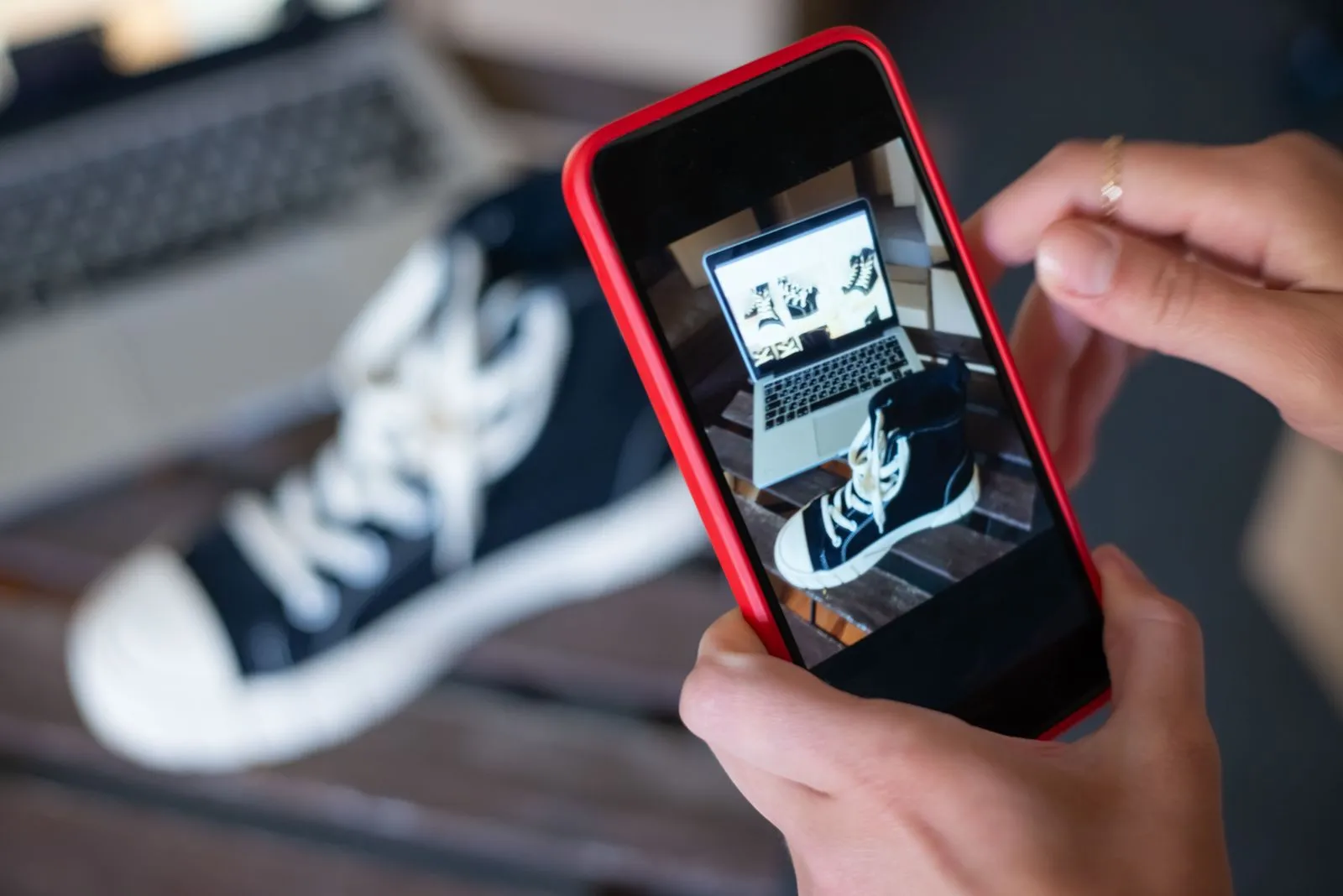
Photos make a review more convincing, which is exactly why they get faked. In our view, be wary of review photos that look like product shots from the store: perfectly lit, on a clean white background, with no kitchen counter, carpet or fingerprint in sight. Real customer photos are usually unremarkable, a bit crooked and show the product in everyday use.
A reverse image search with Google Lens, Bing or TinEye shows whether a review photo already exists elsewhere online. If the same image turns up on the manufacturer's site, in another store or under a different product, the reviewer almost certainly didn't take it. The search won't catch brand-new photos or AI images, though. Our guide on how to tell if an image is AI-generated covers the typical tells, such as warped text on labels and details that don't make sense.
Photos matter even more with brand-name goods. If the reviews show the genuine item and what arrives is a cheap copy, the star rating won't help you. Our guide on how to tell if something is counterfeit shows what to check on the product itself.
If you're writing a critical review yourself, your own photos of the defect make it more credible and help with a return or refund claim too. Our guide to photos as evidence explains how to take pictures that can serve as a record later.
Are fake reviews illegal? What the FTC rule bans
At the federal level, yes, for businesses. In August 2024, the FTC announced a final rule banning fake reviews and testimonials. It targets reviews by someone who doesn't exist, such as AI-generated fakes, or by someone with no actual experience of the business or product. Businesses can't create or sell them, and they can't buy them, get them from insiders or spread them if they knew or should have known they were fake. The FTC can seek civil penalties against knowing violators.
The same rule goes further than invented reviews. According to the FTC, it prohibits:
- Buying sentiment: compensation or other incentives conditioned on writing a review with a particular sentiment, positive or negative.
- Undisclosed insiders: certain reviews by company insiders that don't clearly disclose the connection to the business.
- Fake "independent" review sites: a website the business controls presented as offering independent reviews of its own product category.
- Review suppression: groundless legal threats, physical threats, intimidation or certain false accusations used to prevent or remove a negative review.
- Fake social media influence: buying or selling fake followers or views generated by bots or hijacked accounts to look more influential for commercial purposes.
Note the wording on incentives. The rule, in effect since October 21, 2024, targets incentives tied to a particular sentiment. A free product in exchange for any review, good or bad, therefore isn't automatically illegal under it. According to the FTC's Q&A on the rule, failing to disclose an incentive can still violate the FTC Act.
Ordinary consumers can't be liable under the rule for what they say in reviews, the FTC adds. State consumer protection laws can apply on top of the federal rule, and you can report a business to your state attorney general's consumer protection office.
Fake reviews on Amazon, Google and Trustpilot: what the platforms say
Amazon, Google and Trustpilot ban fake and paid reviews and say they act against them. What matters for you are the labels they show and the limits of those labels.
Amazon: what "Verified Purchase" does and doesn't tell you
Amazon says it analyzes 100% of product reviews before they're posted, using machine learning models and human investigators, and that it proactively stopped more than 250 million suspected fake reviews in 2023. When a reviewer submits a review for a product they bought, it gets a "Verified Purchase" badge. Selling partners can't offer compensation for a positive or negative review. Amazon also runs the Vine program, which sends free samples to members of Vine Voices in exchange for unbiased feedback and labels those reviews as Vine reviews.
Don't read the badge as a seal of authenticity. In our view, it confirms a purchase, not independence: a buyer who gets the purchase price refunded outside Amazon can still show up as verified. If you suspect a review is fake, Amazon asks you to report it right away with the report link next to the review.
Google: removed reviews and warning notices
Google says it takes fake and incentivized reviews on businesses very seriously. When a Business Profile breaks the rules, Google may restrict it. The profile can be barred from new reviews for a set period, or its existing reviews can be unpublished for a while. It can also display a warning that fake reviews were removed. If you see that kind of notice on a business in Google Maps, take it seriously and read the remaining reviews with extra care.
Trustpilot: automated checks and profile notifications
Trustpilot says all submitted reviews are assessed by automated detection systems that analyze IP addresses, device characteristics, location data and timestamps along with the review text. By its own count, it detected and removed 7.8 million fake reviews in 2025. Anyone, business or consumer, can flag a review they think breaks the guidelines. When Trustpilot is investigating a business or has taken action against it, it may place a prominent notification on the business's profile page.
Those numbers mainly show one thing: the filters catch a lot, but not everything. Whatever slips through is yours to judge.
How to report fake reviews on Amazon, Google Maps and Trustpilot
Reporting takes a minute and helps the platform connect the dots. On Amazon, use the report link next to the review. On Google Maps, open the business's reviews, tap the menu next to the review and choose "Report review," then fill out the short form. On Trustpilot, anyone can flag a review they think breaks the guidelines. Tripadvisor, Yelp and Facebook have their own report options on each review. Button labels change from time to time, so look for the option to report or flag that specific review.
Give a concrete reason when you report. "Same wording as three other reviews" or "photo is from the manufacturer's website" helps a moderator far more than a general complaint. Don't report a review just because you disagree with it.
The FTC also wants to hear about suspicious reviews at ReportFraud.ftc.gov. Before you file, take screenshots of the reviews and note the product or business and the page address, since reviews can be edited or deleted.
If you ordered from a store propped up by glowing reviews and never got anything, this is no longer about stars but about your money. Our guide on how to report a fake website covers what to do right away.
Fake review checkers and browser extensions: useful hints, not proof
Search for an app or extension that spots fake reviews and you'll find browser add-ons and websites that scan a product page and hand you a grade. They look for the same patterns you would: review bursts, repetition, suspicious profiles. The best-known one no longer exists. Mozilla shut down Fakespot on July 1, 2025, and Review Checker, the Fakespot feature built into Firefox, ended on June 10, 2025.
In our view, every outside tool has the same limit. It only sees what's publicly on the page. Purchase records, accounts, IP addresses and devices are visible only to the platform itself. Trustpilot, for one, says its systems analyze IP addresses, device characteristics and timestamps. A checker can surface red flags, but it can't prove a review is fake or confirm that one is genuine. Treat its score as a probability, not a verdict.
Also check what an extension is allowed to do. Some ask for access to every website you visit. Install tools only from your browser's official add-on store and read the permissions before you accept.
No tool replaces a quick look of your own. Five minutes spent reading the middle ratings, clicking a reviewer's profile and running one photo through a reverse image search often beat any automated score.
Frequently asked questions about fake reviews
How can you tell if reviews are fake?
Look for patterns rather than single reviews: a burst of top ratings in a short time, almost no criticism, short praise without details, the same phrases in several reviews and reviewers with only one review. Read the three- and four-star reviews, sort by date and compare ratings on more than one site. When several red flags line up, don't rely on the average rating.
Are fake reviews illegal in the US?
For businesses, yes. The FTC's rule on consumer reviews and testimonials, in effect since October 21, 2024, bans creating, buying or selling fake reviews, including AI-generated ones, and reviews by people with no real experience of the product. It also bans incentives tied to a particular sentiment and certain undisclosed insider reviews. The FTC can seek civil penalties against knowing violators.
What does "Verified Purchase" mean on Amazon?
According to Amazon, the badge appears when a reviewer submits a review for a product they purchased. That confirms the purchase, not that the review is independent. A reviewer who gets their money back outside Amazon can still show up as a verified buyer. Read the text critically even when you see the badge.
How do you spot fake reviews on Google Maps?
Check when the reviews were posted, click on reviewers to see what else they've reviewed, and read the middle ratings. Watch for a warning on the business profile: Google says it may display a notice when fake reviews were removed. You can report a suspicious review through the menu next to it by choosing "Report review."
Is there an app or extension that detects fake reviews?
There are browser extensions and websites that scan product pages for typical patterns, but they only see public data, not the purchase records, accounts and devices the platforms can check. Their score is a hint, not proof. The best-known one, Fakespot, was shut down by Mozilla in July 2025. Check an extension's permissions before you install it.
Can a business give you something in exchange for a review?
Under the FTC rule, a business can't offer compensation or other incentives on the condition that the review is positive or negative. Offering a free product for any review, good or bad, isn't automatically banned by the rule, but the FTC says the incentive should be disclosed. Platforms can be stricter, though: Amazon says its selling partners can't offer compensation for a positive or negative review.
Conclusion: spotting fake reviews means reading the pattern
A single review rarely reveals whether it was bought. The overall pattern usually does: review bursts, missing criticism, empty praise, repeated wording, one-review accounts and catalog photos. To spot fake reviews, sort by date, read the middle ratings and run suspicious photos through a reverse image search.
The FTC's rule explicitly bans fake reviews for businesses, and the platforms say they filter out millions of them. Some still slip through. Report what you notice, and for bigger purchases, never rely on the star average from a single site.
About the author

Co-founder & Marketing at TrustCamera
Yannick is a co-founder of TrustCamera and leads marketing and content. He holds a bachelor's and a master's degree in business and has worked in content marketing and SEO for years.